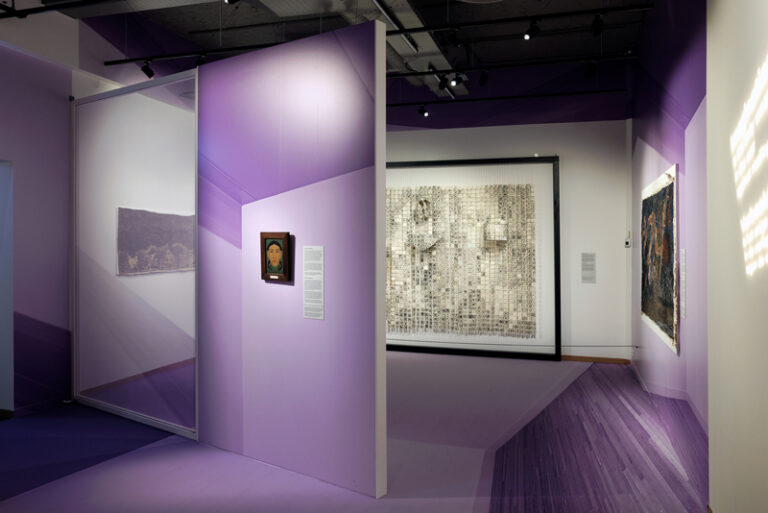
With the exhibition ‘Here We Are! Women in Design 1900 – Today’ Kunsthal presents over a hundred women designers who have all made a crucial contribution to the development of modern and contemporary design.
The spotlights are on these women by using 120 years of design history. The collection of the Vitra Design Museum is the point of departure. From pioneering women at the Bauhaus and designs for the interiors of space capsules to legendary design classics and the women who are currently redefining the profession with their sustainable innovations. Following key moments in this and the past century. The audience gets a wide range of high-quality design pieces, including highlights of renowned Dutch Design.
The exhibition is a grand and wide-ranging retrospective featuring a selection of furniture, ceramics, glasswork, jewelry, fashion and textiles. Examples of graphic design and publications tell the story of the pioneering women who had to compete against the rules of a male-dominated society. Louise Brigham, for instance, published her DIY manual ‘Box Furniture’ in 1909. It provided instructions on how to make your own new furniture from old materials – decades before Gerrit Rietveld would do the same in de 1930s.
Russian space capsules
Gunta Stölzl was the first woman to lead a department at the Bauhaus. There she managed the textile department, which generated a steady source of income for the school. With her unconventional techniques and use of colour, Stölzl possessed an innovative power. A lesser-known school was the Loheland Schule. Located near Fulda in Germany, it only admitted women students. The photographic experiments that were carried out at this school formed the source of inspiration for the artist László Moholy-Nagy’s photograms.
Other legendary designers that are part of the exhibition are Charlotte Perriand, Eileen Gray, Clara Porset and Jeanne Toussaint. Big names from the second half of the 20th century are also present. Greta Magnusson, Liisi Beckmann and Cini Boeri. Galina Balashova was responsible for designing all the interiors for the Russian space capsules between 1963 and 1986.
Here we are: where do we go from here?
Today’s prominent, women designers are Matali Crasset, Patricia Urquiola, Inga Sempé, Ilse Crawford, and the Dutch Hella Jongerius. Many of them have been pushing the boundaries of their discipline. German-born designer Julia Lohmann, for instance, is developing new, sustainable materials within the scope of her research into seaweed.
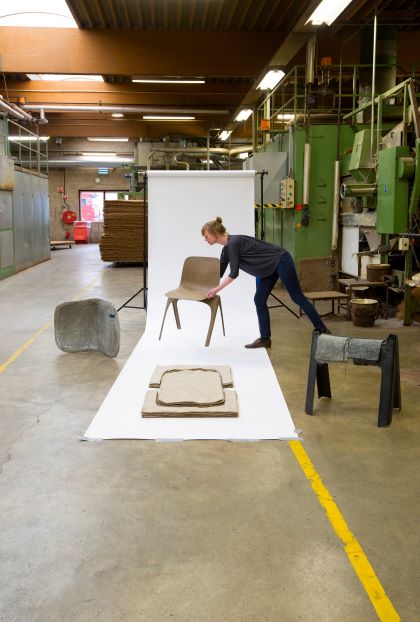
Christien Meindertsma critically investigates production processes. The Rotterdam-based designer developed a biodegradable chair. The Flax Chair is made from reinforced flax: a crop that does not require a huge amount of water to grow.
The exhibition also zooms out in order to reveal a bigger picture and showcase women designers and design collectives from around the globe. Gunjan Gupta, for instance, is bridging the gaps between different cultures. She is inspired by the contrasting bicycle cultures of the Netherlands and India. In collaboration with traditional craft communities in India, she creates her work.
Towards the future
Especially for the exhibition, the collective Matri-Archi(tecture) has created the installation ‘Weaving Constellations of Identity’. Among other things, this platform is dedicated to increasing the visibility and recognition of architecture and design created by black women from the African continent.
Here We Are! is also directing our gaze towards the future. Designers are increasingly asking themselves: How should we shape the future? Guided by the most recent technical developments, designers are approaching major social concerns about the climate, gender, and identity in a multidisciplinary way. Included in the exhibition are projects from social design, urban development, and digital fashion that give a sneak peek of what’s to come in the next 120 years.
The exhibition opens on June 18. It runs until October 30.
Photo: Christien Meindertsma with her Flax Chair by Studio Aandacht