The wondrous world of Paul Delvaux
The mystical world of Paul Delvaux is now on show at the Kunsthal. Naked women, moaning skeletons, classical settings: the Belgian painter juxtaposes all these elements in his incongruous, provocative artworks.
Paul Delvaux (1897-1994) is known as the master of the dream. It is a great title for an artist ranked high on the list of important 20th century Belgian painters, yet despite this he is one of the lesser known. Anyone experiencing the poetic world of Delvaux up close and personal for the first time soon discovers, however, that his work is not something quickly forgotten.
To celebrate its 25th anniversary, the Kunsthal was invited to choose pieces from Delvaux fans Pierre and Nicole Ghêne-Rahm’s private collection, currently housed in Brussel’s Elsene Museum. Pieces from other museums have been loaned out for this large Delvaux retrospective as well, including from Madrid. In total, about 90 paintings, drawings and water colours by the artist are on show.
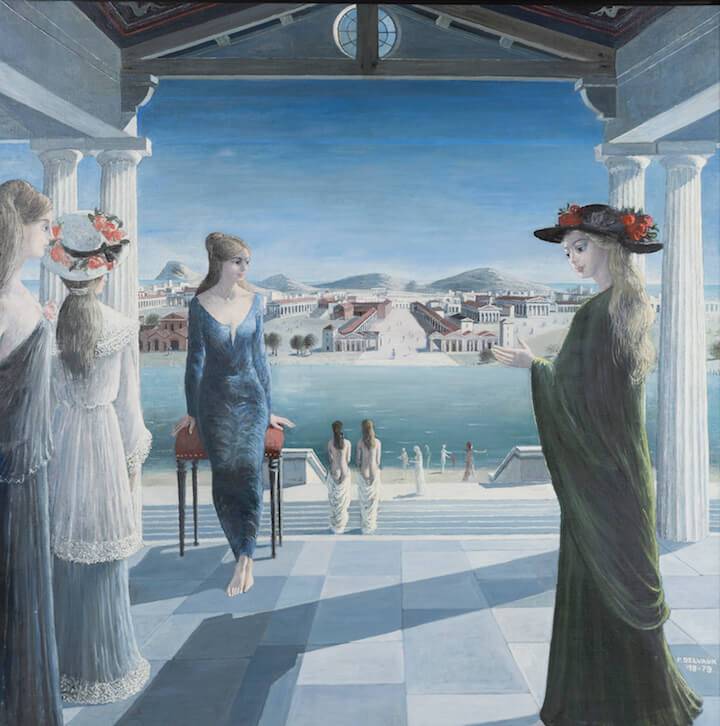
Delvaux had his favourite motifs; women being the most notable, often clad as Eve, sometimes wearing hats, and always with closed or vacant eyes. He places them in unlikely settings, such as ancient classical scenes. Sometimes they seem to be peering from the inside out, or perhaps the other way round, in a nod to his fellow countryman René Magritte, world famous for his Ceci n’est pas une pipe painting among others. Delvaux’s work is influenced by surrealism, yet is not entirely defined as such. The man, who is said to have struggled against a domineering mother most of his life, was possibly too much of a loner for that. He embraces loneliness in his work. Communication does not exist in his mystical world. Nor does he engage in politics.
Classical buildings, trains and train stations, skeletons – these motifs appear everywhere in Delvaux’s paintings. His skeletons are portrayed as moaning creatures witnessing a crucifixion or as beings going about their normal daily business. In Het Appèl, one kneels in an ancient street before a large window. Next to it, a naked woman stares vacantly, while a clothed women inside views her naked self in a mirror, and outside again, in the ancient street, a Barbie-esque figure walks by. The longer you look, the more dispirited the world of Delvaux appears. A woman, naked except for a hat, is placed on a bed, while behind her trains pull into a station. Delvaux’s world is grotesque, carnivalesque and theatrical, but fascinating as well. As the director of Elsene Museum, Claire Leblanc, says: “You just about need a psychiatrist to help dissect Delvaux’s world of women and skeletons.”
Paul Delvaux. On until February 25th, 2018, at the Kunsthal, Museumpark, Westzeedijk 341. Open: Tuesday to Saturday 10am-5pm, Sunday 11am-5pm. kunsthal.nl
Editor: Evelien Baks